
2026年起,公司组建专业外贸团队,直接面向全球客户提供微流体控制产品。通过减少中间环节、提升响应速度,为海外客户提供更具竞争力的产品与服务。
阅读详情2026年是新欣电子国际化战略的元年。经过多年在国内微流体控制领域的深耕,公司在微型气泵、电磁阀等核心产品上积累了深厚的技术底蕴和制造经验。
公司从行业内外招募了一批具有丰富国际贸易经验的专业人才,组建了专业的外贸业务团队。团队成员具备多语种沟通能力,能够快速响应不同国家和地区客户的需求。
通过自主贸易,新欣电子可以直接面向全球客户,省去了传统外贸中多层中间商的加价和服务环节。这不仅让海外客户能够以更具竞争力的价格获得产品,也使得售后支持和技术服务更加高效直接。
公司目前已启动东南亚、中东和欧美市场的拓展计划,通过参加国际展会和线上平台,逐步建立海外品牌知名度。我们相信,凭借过硬的产品质量和专业的服务团队,新欣电子将在全球舞台上展现中国制造的实力。
研发团队在微型气泵无刷电机控制算法方面取得重要进展。通过优化PWM驱动策略和引入智能温控保护机制,新型号产品的平均寿命提升超过40%,能效比显著改善。
阅读详情研发团队经过长达18个月的技术攻关,在微型气泵无刷电机控制算法方面取得了突破性进展。这一技术升级将为公司全系列微型气泵产品带来显著的性能提升。
团队重新设计了PWM(脉宽调制)驱动波形,采用自适应频率调节技术,使电机在不同负载条件下始终保持在最佳工作区间。新算法的响应速度较上一代提升了35%,显著减少了启停时的电流冲击。
通过嵌入温度传感器和实时监测算法,新型号产品能够在温度异常升高时自动调整工作参数,防止过热损坏。这一机制大幅提升了产品在长时间连续运行场景下的可靠性。
经过严格的内部测试和客户试用验证,搭载新控制技术的气泵产品平均使用寿命提升超过40%,能效比提升约25%。特别是在医疗设备、环境监测等对可靠性要求极高的领域,这一突破具有重大意义。
随着全球医疗设备向便携式、家用化方向快速发展,对微型气阀、微型气泵等核心元器件的需求持续上升。预计未来五年市场规模将保持两位数增长。
阅读详情全球医疗设备行业正经历一场深刻的变革——从大型医院专用设备向便携式、家用化方向快速演进。这一趋势为精密微流体控制元件市场带来了前所未有的增长机遇。
从家用呼吸机到便携式血压监测仪,从胰岛素泵到可穿戴健康设备,医疗设备的微型化正在全面加速。每一台便携式医疗设备都需要至少一个微型气泵或微型阀门作为核心驱动元件,市场需求呈指数级增长。
根据多家权威市场研究机构的数据,全球微流体控制元件市场预计在未来五年内将保持两位数增长率。到2030年,市场规模有望突破百亿美元大关。其中,亚太地区由于人口基数大、医疗需求快速增长,将成为增速最快的区域市场。
作为在这一领域深耕超过10年的专业制造商,新欣电子凭借完整的产品线(PM微型气泵、SV电磁气阀、SW电磁水阀)和丰富的定制经验,已经做好充分准备来迎接这一市场机遇。公司将加大研发投入,持续推出适应医疗级需求的高精度、高可靠性产品。

公司微型电磁阀、微型气泵等核心产品已通过国际标准认证,逐步进入东南亚、中东及欧美市场。凭借稳定的品质和快速的交期,赢得了首批海外客户的认可。
阅读详情经过严格的产品认证和充分的市场准备,新欣电子的多款核心产品已成功进入海外市场,标志着公司国际化战略取得了实质性进展。
公司主要产品已通过CE、RoHS等国际标准认证,确保产品符合目标市场的法规要求。认证过程历时一年多,涵盖了PM微型气泵、SV电磁气阀等多个主力产品系列。
目前,新欣电子的产品已出口至东南亚、中东、东欧等多个国家和地区。首批海外客户对产品的稳定性、一致性和交期给予了高度评价。特别是在工业自动化和医疗器械配套领域,我们的产品以出色的性价比赢得了客户的信任。
一位来自东南亚的客户表示:"新欣电子的微型气泵在连续运行测试中表现非常稳定,远超我们的预期。而且他们的技术团队响应速度很快,能够在短时间内提供定制化方案,这对我们的产品开发帮助很大。"
公司计划在2026年下半年参加多个国际行业展会,进一步提升品牌国际知名度。同时将继续扩充外贸团队,完善海外售后服务体系,为全球客户提供更优质的产品和服务。
通过改进阀芯材料和密封结构设计,SW系列电磁水阀的耐压性能提升约30%,泄漏率进一步降低至行业领先水平。该升级已应用于所有SW系列新品。
阅读详情技术团队历时8个月,对SW系列电磁水阀进行了全面的密封技术升级。这一升级涉及材料科学、结构设计和加工工艺三个维度的创新。
团队引入了新型高分子复合材料替代传统的橡胶密封件。新材料具有更好的耐化学腐蚀性和更低的永久压缩变形率,在长时间使用后仍能保持良好的弹性恢复能力。
通过有限元分析和流体动力学仿真,团队重新设计了密封面的几何结构。新的双密封环设计使泄漏通路减少了一半以上,同时优化了流体通道以减少湍流和压降。
升级后的SW系列产品耐压性能提升约30%,泄漏率降低至行业领先水平(<0.05ml/min)。在100万次开合寿命测试中,密封性能衰减不超过5%。这一升级已应用于所有SW系列新品,并持续获得客户的积极反馈。
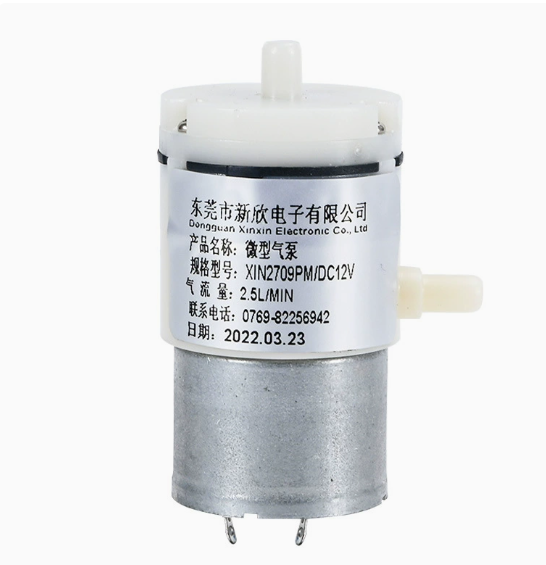
A mass-produced core model from Dongguan Neuxin Electronics: the XIN2709PM micro air pump (DC12V) combines performance, lifespan and cost — an ideal fit for medical, industrial, beauty and household devices.
Read moreEngineers and procurement specialists in device R&D and manufacturing know the pain points of component selection all too well: a stable, reliable micro air pump directly determines the performance and lifecycle of the end product. Low flow that cannot drive the load, insufficient vacuum for process requirements, short high-frequency lifespan, excessive noise complaints, poor air-tightness causing performance decay… Today we solve these matching and selection pain points once and for all.
We present a core mass-produced model from Dongguan Neuxin Electronics — the XIN2709PM Micro Air Pump (DC12V), a small DC vacuum pump that balances performance, lifespan and cost, and is a worry-free choice for medical, industrial, beauty and household device integration.
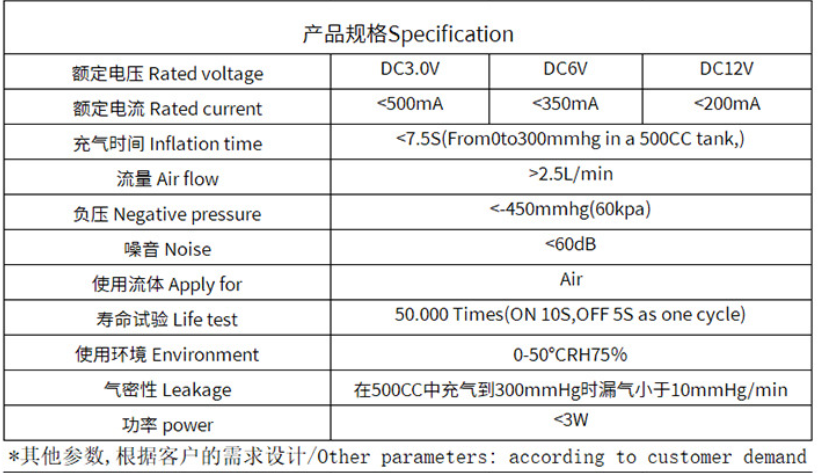
Rated flow > 2.5 L/min, peak vacuum up to -450 mmHg (60 kPa). A 500 CC sealed vessel fills from 0 to 300 mmHg in under 7.5 seconds, responding quickly in both inflation and suction scenarios and easily meeting the power needs of most small devices. The full range covers DC3.0V / DC6V / DC12V rated voltages; the flagship 12V version draws < 200 mA, total power < 3 W — a low-power design that adapts to all kinds of DC-powered terminal devices.
Operating noise is strictly controlled within 60 dB with smooth, stable running and no harsh harmonics. Whether for consumer-near devices such as medical nebulizers and home beauty instruments, or laboratory analyzers and indoor office equipment, it causes no noise interference and directly raises the perceived quality of the end product.
Standardized life testing confirms 50,000 start-stop cycles (10 s on / 5 s off per cycle), resisting wear under high-frequency duty and greatly reducing device after-sales rates. Air-tightness is equally excellent: when a 500 CC sealed vessel is inflated to 300 mmHg, leakage is less than 10 mmHg per minute — stable pressure retention that eliminates performance decay and out-of-spec parameters caused by pump leakage.
Standard micro-pump architecture: compact, flexible mounting, directly embeddable inside various small devices without major structural changes. Perfect for both new-product R&D selection and legacy-product performance upgrades, drastically shortening project cycles.
We are Dongguan Neuxin Electronics, with years of expertise in micro air pumps and micro solenoid valves. We support parameter customization, voltage adjustment and performance optimization, and develop one-to-one solutions for your device needs. Bulk purchasing, custom development and sample testing are all available — source-factory direct supply with stable full-process quality control and reliable lead times for volume orders.
If you are looking for a stable, reliable micro air pump supplier, leave a message in the comments or contact us privately for a free product specification sheet and sample quote.
做设备研发、生产采购的同行都懂:一款稳定靠谱的微型气泵,直接决定了终端设备的使用效果和生命周期。流量带不动负载、负压达不到工艺要求、高频使用寿命短、噪音超标遭客户投诉、气密性差导致效果衰减……这些配套选型的痛点,今天一次性解决。
给大家推荐我们东莞市新欣电子的核心量产款 ——XIN2709PM 微型气泵(DC12V),一款兼顾性能、寿命与成本的高性价比小型直流气泵,是医疗、工业、美容、家电类设备配套的省心之选。
这款微型真空泵额定流量>2.5 L/min,峰值负压可达 -450 mmHg(60 kPa),500 CC 密闭容器从 0 充气至 300 mmHg 仅需不到 7.5 秒,充气抽气双场景都能快速响应,轻松满足绝大多数小型设备的动力需求。全系列覆盖 DC3.0V / DC6V / DC12V 三种额定电压,其中主推的 12V 款额定电流<200 mA,整机功率<3 W,低功耗设计更节能,完美适配各类直流供电的小型终端设备。
工作噪音严格控制在 60 dB 以内,运行平稳无刺耳杂音。不管是医疗雾化器、家用美容仪这类贴近用户的民用设备,还是实验室分析仪器、室内办公设备,都不会造成噪音干扰,直接拉高终端产品的使用质感。
经过标准化寿命测试,可承受 50000 次启停循环(开 10 秒 / 停 5 秒为一个循环),高频工况下长期使用不易损耗,大幅降低设备售后率。气密性表现同样优异:500 CC 密闭容器充气至 300 mmHg 时,每分钟漏气量小于 10 mmHg,保压效果稳定,彻底杜绝因气泵漏气导致的设备效果衰减、参数不达标问题。
标准微型泵体结构,体积小巧、安装灵活,可直接内嵌进各类小型设备内部,无需大幅改动设备原有结构,适配性极强。新设备研发选型、老产品性能升级,都能快速落地,大幅缩短项目周期。
我们是东莞市新欣电子,专注微型气泵、微型电磁阀等精密流体控制产品研发生产多年,支持参数定制、电压调整、性能定向优化,可根据客户设备需求一对一开发适配。批量采购、定制开发、拿样测试均可对接,源头工厂直供,全流程品控稳定,大货交期有保障。
如果您正在找稳定靠谱的微型气泵配套供应商,欢迎评论区留言或私信咨询,可免费获取产品详细规格书与样品报价。
Buying micro air pumps, water pumps, solenoid valves or oil-free compressors, you cannot judge a supplier by unit price alone. This guide gives a ready-to-use "six-dimension supplier evaluation + IQC sampling + lead-time/MOQ control" method.
Read moreDirect answer: when buying micro air pumps, water pumps, solenoid valves or oil-free compressors, you cannot choose a manufacturer by unit price alone. For B2B procurement and R&D of portable nebulizers, water-quality samplers, small drinking/coffee devices and medical instruments, what truly determines yield and delivery is the supplier's quality system, on-time delivery rate, batch consistency, customization capability and compliance traceability.
This article provides a ready-to-use "six-dimension supplier evaluation + incoming inspection (IQC) sampling + lead-time/MOQ control" method to upgrade "pump selection" into "supply-chain management" and avoid the two big pitfalls of incoming defects and delivery breaches.
Three things make them unlike ordinary standard parts: parameter dispersion (flow, pressure and noise vary with diaphragm batch, assembly clearance and motor consistency); high cost of failure (a leaking or noisy DC12V micro pump can block an entire instrument at final inspection); and compliance traceability (materials for medical, food and export scenarios — RoHS/REACH/food-grade and electrical safety IEC 60601-1 — need a traceable report chain).
Best practice grades suppliers A/B/C/D: 12 consecutive months defect-free → waived or reduced inspection (A); >98% pass → normal inspection (B); 90–98% → tightened + special audit (C); below 90% → suspend supply and develop new sources (D).
Use GB/T 2828.1 (equivalent to ISO 2859-1) for acceptance-sampling by attributes: define defect classes, then AQL and inspection level (IL).
Must-check IQC items: flow/pressure (per spec lower limit); noise (ISO 3744 / GB/T 3768); leakage (solenoid/water pump pressure-retention, e.g. solenoid leakage < 10 mmHg/min); insulation/withstand voltage (IEC 60601-1 for medical); appearance & assembly.
Qualified ≠ consistent. Build Statistical Process Control (SPC) on flow, noise and current of each batch (GB/T 4091 / ISO 7870), monitoring whether mean and range exceed 3σ limits. Pair the supplier's batch aging data with your SPC data to close the loop.
Requirement → Sample (7–15 days with spec sheet & test data) → Integration (system-level flow/noise/temperature rise) → Validation (reliability & IQC, batch consistency) → Volume (lock process & inspection, switch to SPC). Fix requirements with a written "email/drawing confirmation sheet" to avoid verbal changes.
From a TCO perspective, factoring "incoming defect rate × rework cost + delivery-breach cost" often makes a supplier 5% cheaper on unit price but double the defect rate the more expensive choice. Write the above six items into the technical agreement rather than merely comparing prices.
Maturity in micro pump/valve procurement has three tiers: tier 1 compares unit price, tier 2 compares parameters, tier 3 compares supplier system and consistency. With IQC by standard, batch SPC control, closed-loop customization and traceable compliance, your yield won't "depend on luck."
Q1: What indicators matter most for supplier evaluation?
A: Six dimensions — quality system (ISO 9001, ISO 13485 for medical), capacity & on-time rate, customization (voltage/interface/mounting), product breadth, compliance support (RoHS/food-grade/medical safety), service response. Shortlist by parameters, stay long-term by system & consistency.
Q2: What standard to sample incoming inspection by?
A: GB/T 2828.1 (ISO 2859-1). Critical → C=0; Major (flow/pressure/noise out of spec) AQL 0.65–1.0; Minor (appearance) AQL 2.5–4.0. New suppliers or critical parts use inspection level III; stable long-term use I.
Q3: Typical lead time & MOQ?
A: Prototypes 7–15 days, MOQ a few to dozens; volume ramp needs capacity locked early, 1–2 months safety stock for key pumps, 8–12 week peak-season forecast. Spec voltages (e.g. DC12V, AC220V) are one version only — customize to terminal supply.
Q4: Typical lifespan?
A: Conservative duty values. E.g. oil-free compressor continuous life ≥5000 h; diaphragm air pump (XIN3205PM) diaphragm cycle life 80,000; water pump diaphragm ~18,000 cycles. Confirm per spec & duty.
Q5: What can Neuxin cooperate on?
A: Four product lines; multi-voltage customization (AC220V/AC110V/DC12V/DC24V); cooperation on RoHS, food-grade (GB 4806), medical electrical safety (IEC 60601-1), IP rating; samples & technical interface within spec.
直接回答:买微型气泵、微型水泵、微型电磁阀、微型无油压缩机,选厂家不能只看单价。对做便携式雾化器、水质采样仪、小型饮水/咖啡设备、医疗仪器的 B2B 采购和研发来说,真正决定整机良率与交付的是供应商的质量体系、交期达成率、批次一致性、定制能力与合规追溯。本文给出一套可直接落地的"供应商六维评估 + 来料检验(IQC)抽样 + 交期 MOQ 管控"方法,帮你把"选泵"升级为"管供应链"。
三件事决定了它不能当普通标准件买:参数有离散(流量、压力、噪音受膜片批次、装配间隙、电机一致性影响);不良代价高(气泵/水泵是整机"流体心脏",一颗泄漏或噪音超标的 DC12V 微型气泵可能让整批仪器在出厂检验卡住);合规要追溯(医疗、食品、出口场景,材料 RoHS/REACH/食品级与电气安全 IEC 60601-1 都要有可追检的报告链)。
行业最佳实践把供应商分 A/B/C/D 级:连续 12 个月零缺陷可放宽甚至免检(A 级),合格率 98% 以上正常检验(B 级),90%~98% 加严+专项审核(C 级),低于 90% 暂停供货并开发新源(D 级)。
到货要按 GB/T 2828.1(等同 ISO 2859-1)做计数调整型抽样:先定缺陷分级,再定 AQL 和检验水平(IL)。
IQC 必检项目:流量/压力(按规格书下限卡);噪音(ISO 3744 / GB/T 3768);泄漏(电磁阀/水泵保压,如漏气 <10 mmHg/min);绝缘/耐压(医用按 IEC 60601-1);外观与装配。
合格 ≠ 一致。用统计过程控制(SPC):对每批抽检的流量、噪音、电流建控制图(GB/T 4091 / ISO 7870),监控均值与极差是否超出 3σ 控制限。把供应商的批次老化数据和你的 SPC 数据对起来,形成闭环。
需求 → 样品(7~15 天出样,附规格书与测试数据)→ 集成(装进整机测系统级流量/噪音/温升)→ 验证(跑可靠性与 IQC,确认批次一致)→ 量产(锁定工艺与检验标准,转 SPC 管控)。避坑:定制需求用"邮件/图纸确认单"固化,避免口头变更。
总拥有成本(TCO)视角:把"来料不良率 × 整机返工成本 + 交期违约成本"算进去,往往比单价便宜 5% 但不良率高一倍的供应商更贵。把上面六项写进技术协议,比单纯比价更能控风险。
微型泵阀采购的成熟度分三层:第一层比单价,第二层比参数,第三层比供应商体系与一致性。做到 IQC 按标准抽样、批次用 SPC 管控、定制走闭环、合规可追溯,整机良率才不会"看运气"。
Q1:微型泵阀供应商主要评估哪些指标?
A:六维——质量体系(ISO 9001,医疗加 ISO 13485)、产能与交期达成率、定制能力、品类齐全度、合规支持、服务响应。入围看"参数",长期看"体系与一致性"。
Q2:来料检验按什么标准抽样?
A:GB/T 2828.1(ISO 2859-1)。致命 C=0;主要(流量/压力/噪音不达标)AQL 0.65~1.0;次要(外观)AQL 2.5~4.0。新供应商或关键件用 III,长期稳定用 I。
Q3:交期多久?MOQ 多少?
A:研发打样 7~15 天、MOQ 几颗到几十颗;量产需提前锁产能,关键泵安全库存 1~2 个月,旺季提前 8~12 周预测。规格书电压(如 DC12V)仅为其中一个版本,实际可按终端供电定制。
Q4:寿命一般多久?
A:以保守工况值为准。如微型无油压缩机连续运行 ≥5000 h;微型隔膜气泵(XIN3205PM)膜片循环 8 万次;微型水泵膜片约 1.8 万次。
Q5:新欣能配合什么?
A:四条产品线齐全,支持多电压定制,可配合 RoHS、食品级、医用安全、IP 防护等送检,提供规格书范围内样品与技术对接。
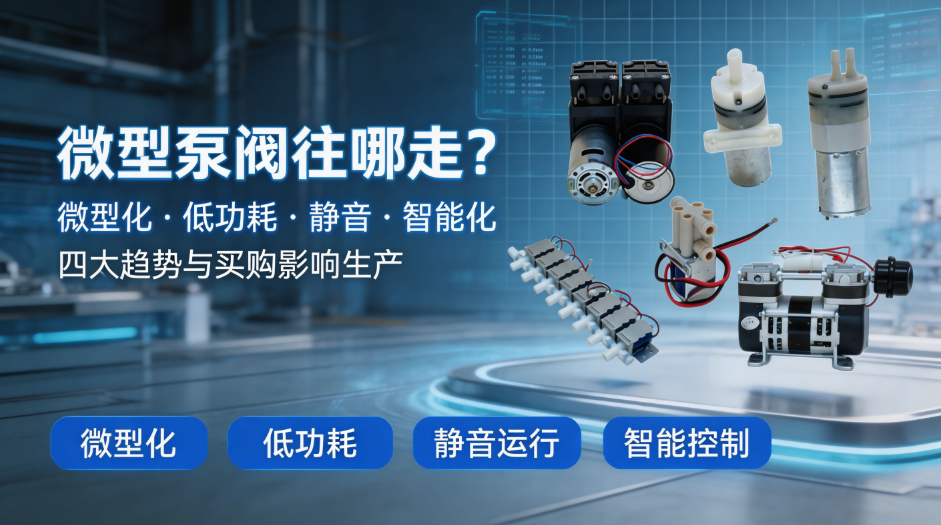
Miniaturization, low-power/brushless, silence and intelligence are reshaping micro fluidics. We map the four main trends and what they mean for your 2026 selection and procurement.
Read more
Over the previous articles we broke down testing SOPs, industry solutions, compliance, selection calculation, fault diagnosis, manufacturer comparison, material selection, deep dives, application cases and maintenance. Today we change perspective — not "how to use" but "where it's going." For B2B procurement and R&D, seeing the technology trend avoids "selecting something already obsolete"; for manufacturers, trends define the next round of product definition.
Demand has shifted from traditional industrial instruments and appliances toward portable medical devices, wearables, point-of-care testing (POCT), environmental monitors and consumer-electronics cooling. These scenes share: smaller, lighter, battery-capable, quiet, reliable. Market data: electromagnetic (diaphragm/piston with BLDC) holds ~38.5% share, piezoelectric ~32.1%; within MEMS micro-pumps piezoelectric leads at ~49.6%. "More efficient, more power-saving, quieter" micro-fluidic solutions are becoming the mainstream buyer's priority.
Smaller volume, lighter weight, higher flow/pressure per unit volume. Real Neuxin figures: XIN2701BPW water pump 25 g (DC12V, ~1300 ml/min); XIN3205PM air pump 78.1 g (DC12V, ≥10 LPM, >110 kPa); XIN2702PW water pump 60 g (DC12.0V, 1200 ml/min). A 78.1 g diaphragm pump delivering >110 kPa means motor, diaphragm chamber and check valves integrated into a palm-sized space — exactly why portable nebulizers and handheld samplers adopt micro diaphragm pumps.
Battery-powered devices (nebulizers, gas detectors, wearable infusion pumps, field samplers) demand low power. Piezoelectric micro-pumps (no seals, no rotating parts) can save ~50–80% power versus electromagnetic — ideal for microliter/milliliter, long-endurance portable and implantable scenes. Brushless DC (BLDC) motors raise efficiency and lifespan (IEC 60034-1, IEC 61800-5-1). For portable devices, battery safety needs IEC 62133. When selecting, view rated power, locked-rotor/no-load current and standby current together, and calculate endurance with the actual (customizable) supply voltage.
Noise comes from motor magnetics, diaphragm reciprocation, flow pulsation and structural resonance. Neuxin examples: XIN2701BPW <58 dB (drinking/coffee/desktop); XIN2702PW <65 dB (cooling/analysis); XIN8502PM-2 compressor ≤55 dB (silent source, medical/lab); XIN3205PM <70 dB (nebulizer/sampler). Measure per ISO 3744, ISO 11201, GB/T 3768, and require the supplier's test conditions (distance, background correction) at acceptance.
From "on when powered, off when cut" to a smart actuator that senses, feeds back and communicates: built-in sensors (flow/pressure/temperature/position) for constant flow/pressure; intelligent drive (PWM / VFD, soft-start, stall protection, IEC 61800); condition monitoring (vibration, temperature, current trend, ISO 17359). For OEMs this means defining interfaces and protocols at system level. Reality: not every pump needs a chip — basic protection + external monitoring is already a big step; closed-loop for high-value medical/instrument scenes.
Oil-free avoids oil contamination (medical, food, clean labs) and eliminates oil changes. Wetted parts evolve toward media-resistant, biocompatible, food-grade materials (RoHS/REACH, GB/T 26572, IEC 63000; GB 4806 food contact; ISO 10993 biocompatibility; ISO 13485 for medical).
Buyers want fast customization: multi-voltage (AC220V/AC110V/DC12V/DC24V), structural customization (port orientation, mounting, dampers like XIN8502PM-2's 24×26.5 mm, 72–75 hardness damper), and four parallel product lines for one-stop fluid actuation. Note: customization is not "anything changeable" — material grade, extreme life and obtained certifications must follow the actual spec sheet and test report.
Multi-voltage customization across all four lines; samples & prototyping within spec; compliance testing cooperation (RoHS, food-grade GB 4806, medical IEC 60601-1, IP); technical interface for miniaturization, low-power, silence and condition monitoring.
The next stop for micro pumps/valves is smaller, more power-saving, quieter, smarter. For buyers, expand the selection list from "flow/pressure" to six dimensions; for makers, define products around real OEM scenes. Trends won't change the landscape overnight, but will quietly screen out suppliers who "can't keep up."
前面我们把微型泵阀的测试 SOP、行业方案、合规认证、选型计算、故障诊断、厂家横评、材料选型、单品深度、应用案例、保养维护都拆了一遍。今天换个视角——不讲"怎么用",讲"往哪走"。对 B2B 采购和研发来说,看清技术趋势,才能避免"刚选型就过时";对制造端来说,趋势就是下一轮产品定义的方向。
过去十年,微型泵阀的需求拉力从传统工业仪表、家电,转向便携医疗设备、可穿戴、床旁诊断(POCT)、环境监测仪器、消费电子散热。这些场景共同点——设备要小、要轻、要电池能撑、要安静、要可靠。市场数据:电磁式(含隔膜/活塞,配无刷直流电机)约占 38.5% 份额,压电式约占 32.1%;MEMS 微泵中压电式约 49.6% 主导。"更高效、更省电、更安静"正成为主流买家的优先选项。
更小的体积、更轻的重量、单位体积更高的流量/压力。新欣真实参数:XIN2701BPW 微型水泵 25 g(DC12V,~1300 ml/min);XIN3205PM 微型气泵 78.1 g(DC12V,≥10 LPM、>110 kPa);XIN2702PW 微型水泵 60 g(DC12.0V,1200 ml/min)。78.1 g 隔膜气泵能提供 >110 kPa,意味着动力组件、膜片腔、单向阀高度集成在掌心大小空间里。
越来越多设备电池供电。压电式微型泵无机械密封、无旋转件,比电磁式省电约 50%~80%;电磁式(无刷直流电机)靠 BLDC 提升效率与寿命(IEC 60034-1、IEC 61800-5-1),电池安全还需 IEC 62133。选型时把额定功耗、堵转/空载电流、待机电流三项一起看,并用实际供电电压核算续航。
噪音来自电机电磁噪声、膜片往复、气流脉动、结构共振。新欣指标:XIN2701BPW <58 dB(饮水、咖啡、桌面);XIN2702PW <65 dB(小型冷却、分析);XIN8502PM-2 压缩机 ≤55 dB(静音气源、医疗/实验室);XIN3205PM <70 dB(雾化、采样)。按 ISO 3744、ISO 11201、GB/T 3768 测,验收时要求厂家提供测试条件(测点距离、背景修正)。
从"通电就转"到可感知、可反馈、可通讯的智能执行器:内置传感器(流量/压力/温度/位置)实现恒流恒压;智能驱动(PWM/变频、软启动、堵转保护,IEC 61800);状态监测(振动、温度、电流趋势,ISO 17359)。现实边界:智能化不等于"每颗泵都加芯片",成本敏感场景先做到基础保护+可外接监测已是显著进步。
无油、免维护避免油雾污染(医疗、食品、洁净实验室),材料向更耐介质、更生物相容、更食品级演进(RoHS/REACH、GB/T 26572、IEC 63000;GB 4806 食品接触;ISO 10993 生物相容;ISO 13485 医疗)。
买家希望按供电、接口、安装、介质快速定制:多电压(AC220V/AC110V/DC12V/DC24V);结构定制(出气/出水口朝向、安装脚位、减震柱如 XIN8502PM-2 的 24×26.5 mm、硬度 72~75);四线并行便于"一站式"配齐。注意:定制不是"什么都能改",材质牌号、极限寿命、已获认证须以实际规格书与检测报告为准。
多电压定制(全线);规格书范围内样品与打样;配合 RoHS、食品级(GB 4806)、医用电气安全(IEC 60601-1)、IP 防护等送检;针对微型化、低功耗、静音、状态监测提供选型与集成建议。
微型泵阀的下一站是更小、更省电、更安静、更聪明。对买家,选型清单从"流量压力"扩展到六维;对制造端,产品定义要围绕整机厂真实场景做减法与加法。趋势会悄悄把"跟不上"的供应商筛出去。
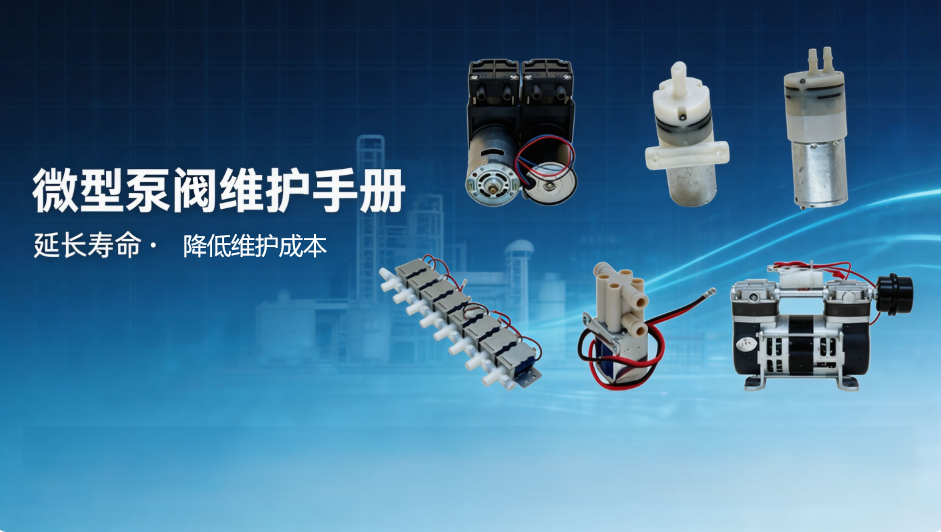
A preventive maintenance manual for micro air pumps, water pumps, solenoid valves and oil-free compressors: daily/weekly/monthly/quarterly tasks, storage and condition monitoring to lower total cost of ownership.
Read more
The "fault diagnosis" article covered repair after failure — reactive. This one covers daily maintenance, how to fail less or not at all, and how to cut O&M cost — proactive. Together they form the "prevention–repair" closed loop. For B2B buyers, a pump's life and stability often matter more to TCO than its unit price.
Reactive repair = unplanned downtime + secondary damage + emergency-part premium. Proactive maintenance intervenes within the detectable failure window, turning a sudden crash into a planned minor repair. International practice (ISO 17359:2018) builds a condition-monitoring system: equipment audit & FMEA → monitoring parameters & health baseline → alarm limits → data, diagnosis, prognosis, feedback. For micro pumps/valves in volume use, just watch three easy metrics — vibration, temperature, working current — to catch most degradation early.
Three "life-saving" taboos: must add ≤40 μm filter at intake; never block the outlet and deadhead for long; never let liquid/condensate into the chamber.
Four misconceptions: not all micro pumps self-prime; nameplate head ≠ actual head; higher voltage ≠ higher flow; diaphragm pumps can't convey arbitrary liquids (check media compatibility, e.g. EPDM vs petroleum solvents).
Three principles: clean medium; avoid frequent switching; avoid harsh environment.
Taboos: single continuous run ≤8 h; prevent dust/moisture/corrosive gas intake; avoid long idle running. Long idle (>1 week): power off, manually rotate rotor to prevent seizure, store dry.
Relative humidity 40%~60% RH (≤70% upper limit); temperature 15~25°C (precision 20±2°C), daily swing ≤5°C; absolutely no condensation; dust ≤10 mg/m³, no acid/alkali/salt mist; off wall ≥30 cm, off floor ≥10 cm; wake every 1~3 months with 10~30 min no-load run. Coat bare metal with thin rust-proof oil; use breathable dust cover, NOT airtight plastic film.
Track three easy metrics as trends: vibration (ISO 10816/20816); temperature (shell/coil/bearing); working current (abnormal rise = aging/jamming early warning). Build a baseline when healthy, set alarms from baseline and standards, then trend — turning sudden failures into planned repairs.
1) Write "maintenance cycle & wear-part list" into the procurement technical appendix. 2) Require the supplier's "health baseline data" (factory flow/pressure/current/noise typical values). 3) Choose materials by duty, set cycles by duty, and confirm wetted-material compatibility early.
Q1: Are micro pumps "maintenance-free"? No — oil-free saves oil changes, but diaphragms, valves and seals are still wear parts; "low maintenance" ≠ "zero maintenance."
Q2: Storing a year then restarting? Manually rotate/ jog to confirm no seizure, then step-load (30%/60%/100%), re-measure flow/pressure/current vs baseline.
Q3: Can an IP67 pump sit in water long-term? No — IP67 is short immersion only; long submersion exceeds design and hurts seal life.
Q4: How much does unstable voltage hurt? Over-voltage raises speed and multiplies brush/motor loss, sharply shortening life; keep fluctuation within ±10%, measured at the leads.
"故障诊断图解"讲设备坏了之后怎么修——被动抢修。这一篇反过来,讲日常怎么保养、怎么让设备少坏甚至不坏、怎么把运维成本压下来——主动预防。两者构成"预防—抢修"完整闭环。对 B2B 买家,泵的寿命和稳定度往往比采购单价更影响总拥有成本(TCO)。
被动维修代价=非计划停机损失+二次损坏+紧急备件溢价。主动保养在故障可探测窗口内提前干预。ISO 17359:2018 给出状态监测通用框架:设备审核与 FMEA → 选监测参数建健康基线 → 设报警限 → 采集诊断预后反馈。对批量使用的微型泵阀,只需盯住振动、温度、工作电流三个最容易测的指标,就能提前发现大多数退化征兆。
三条"保命"禁忌:进气前端必须加 ≤40 μm 过滤器;禁止长时间出口堵死憋压;严禁液体/冷凝水吸入泵腔。
四大误区:并非所有微型泵都能自吸;标称扬程≠实际扬程;电压越高流量越大(错);隔膜泵可输送任意液体(错,须做介质兼容)。
三条原则:介质干净;避免频繁开关;避免恶劣环境。
禁忌:单次连续 ≤8 h;防粉尘/水汽/腐蚀性气体吸入;避免长时空转。长期停用(>1 周)断电后手动盘动防粘连,存干燥处。
相对湿度 40%~60% RH(≤70% 上限);温度 15~25℃(精密 20±2℃),日温差 ≤5℃ 防凝露;绝对禁凝露;粉尘 ≤10 mg/m³,无酸碱盐雾;离墙 ≥30 cm、离地 ≥10 cm;每 1~3 个月通电空载 10~30 分钟驱潮。金属裸面涂薄防锈油;电气柜放变色硅胶;用透气防尘罩,不要用不透气塑料膜全包。
把振动(ISO 10816/20816)、温度、工作电流三个指标做成趋势记录:建基线 → 设报警 → 做趋势,把突发变成计划维修。哪怕只"每周记一次电流和温度",也已迈进状态监测大门。
1)把"保养周期和易损件清单"写进采购技术附件。2)要求供应商提供"健康基线数据"。3)按工况选材质、按工况定周期,提前确认过流材质兼容性。
Q1:微型泵是不是"免维护"? 无油泵省去换油,但膜片、阀片、密封件仍是易损件,"低维护"≠"零维护"。
Q2:库存一年再启用? 先手动盘动/点动确认无卡滞,再阶梯式加载(30%/60%/100%),复测流量压力电流是否回到基线。
Q3:IP67 泵能长期泡水里? 不能。IP67 仅短时浸没防护,长期水中运行会超设计条件。
Q4:电压不稳定影响多大? 超压使转速上升、电刷/电机损耗成倍加快,寿命大幅缩短;波动控制在 ±10% 以内,并在泵引线端实测。
A factory-level fault-diagnosis guide for micro air pumps, water pumps, solenoid valves and oil-free compressors: symptom → cause → fix, plus a PM plan and a decision tree from symptom to root cause.
Read moreWhy fault-diagnosis capability = procurement decision power: in mass production, the worst fear isn't "bought too expensive" but "frequent failures with no root cause." A portable device with a micro air pump complains "pressure drops over time" — is it the pump, the valve, or the piping? Quick locating tells you whether to change supplier or optimize the system. Industry stats: 60%~80% of pump failures are avoidable by preventive maintenance; bearing faults are 45% of pump faults, seal faults 30%. Mastering fault-tree diagnosis lets you evaluate a supplier's reliability engineering at the procurement stage.
Insufficient pressure / reduced displacement: clogged intake filter → clean/replace; joint leakage (soapy water) → tighten/reseal; worn internal seals → replace; worn exhaust valve → replace; low voltage → adjust to rated; mismatched selection → reselect.
No start after power-on: confirm power → check fuse → confirm switch/wiring → internal motor fault (brush wear/coil short) → replace brush or repair coil.
Excessive noise: metal friction → bearing/lubrication; sharp whistle → blocked air path/valve; dull hum → phase loss/voltage; periodic knock → impeller imbalance/shaft bend; vibration → loose base/screws.
Overheating: poor ventilation → improve; insulation aging/short → measure insulation; bearing wear → replace; long overload → reduce load. Note: overheating accelerates insulation aging; add a temperature sensor with alarm ~85°C.
No/low output: check water level → pipe blockage/valve → power/fuse → diaphragm rupture (remove 3 screws) → impeller damage/direction → seal leakage. Motor runs but no pumping: ruptured diaphragm → replace; failed check valve → clean/replace; air in chamber → re-prime; line clogged → blow clear. Pump won't stop: usually a system leak — find and fix it. Diaphragm note: diaphragm faults are >60% of faults; dry-run 10 min ≈ 20 h normal wear — always prime before start.
No action after power: loose wiring → tighten; voltage in range → adjust; coil open (ohmmeter) → replace coil; spool jammed by debris → clean (clearance <0.008 mm, easily jams); check differential pressure. Leaking/not sealing: worn seals → replace; spool jammed → clean + add filter; spring fatigue → replace; orifice blocked → clean; wrong installation direction → reinstall per arrow; spool wear → replace spool. Coil overheating/burn: long energization → use latching/low-power coil; voltage mismatch → verify rating; moisture → dry; high ambient → add cooling; frequent switching → reduce frequency. Noise when energized: dirty armature face → clean; voltage fluctuation → adjust; loose mount → secure.
Low pressure / slow build: clogged air filter → clean/replace; joint/hose leak (soapy water) → tighten/reseal; worn piston ring/valve → replace; pressure-switch anomaly → recalibrate; safety-valve leak → replace; check valve fault → replace. Overheat trip / frequent breaker: dirty fins/poor ventilation → blow clean; long overload → intermittent (15 min run / 10 min cool); intake blockage → clean; fan failed → repair; low voltage → check; internal wear → overhaul. Abnormal vibration: uneven placement/loose screws → level/tighten; metal impact → stop immediately, repair; belt slack → tension; damper aging → replace (e.g. XIN8502PM-2 damper 24×26.5 mm). Water in air: high humidity/no daily drain → drain daily; add dryer/filter; shorten pipe, lower temp.
60%~80% of failures are avoidable by PM. Daily: visual leak, abnormal noise, bearing/shell temp (>85°C check), outlet pressure/flow (deviation >10% investigate), motor current, compressor drain. Weekly: tighten bolts, clean filter, check belt tension. Monthly: seal/O-ring elasticity, vibration measurement (ISO 10816), solenoid actuation test. Quarterly: vibration spectrum, flow/pressure test, pump-motor alignment, insulation (IEEE 43). Yearly: full teardown, performance curve retest, NPSH recalc. Wear-part intervals: mechanical seal 800~1500 h; bearing 2000~3000 h; diaphragm 2000~5000 h; O-ring 6~12 months; air filter by hours.
Level 1 External: power normal? voltage ok? wiring firm? fuse ok? → Level 2 Duty: medium enough? line clear? filter clean? valves open? → Level 3 Performance: pressure/flow ok? noise/vibration abnormal? temp too high? → Level 4 Internal: seals ok? bearing clearance? valve/diaphragm worn? impeller intact? → Level 5 System: selection matched? duty within design? reselect needed?
1) Require the supplier's FMEA document. 2) Build a PM archive with run-hour records and data-driven spares. 3) Run accelerated life verification on 2~3 pre-production samples (to 80% of rated cycles) and check the decay curve.
Q1: Pressure drops after use — quality issue? Not necessarily; check filter, joint leakage, voltage first. Q2: Solenoid hums but won't actuate? Verify voltage; if ok, spool likely jammed by debris — clean. Q3: Water pump died after a few min dry-run? Diaphragm dry-run damage is severe; always prime first; add dry-run protection. Q4: Compressor drain daily? Yes — condensate causes rust/corrosion. Q5: DC/AC coils interchangeable? No — impedance/start current differ; wrong connection burns the coil. Q6: Noise rises but performance ok? Stop and inspect — usually bearing wear or loose screws.
为什么故障诊断能力 = 采购决策力:B2B 采购微型泵阀,最怕的不是"买贵了",而是量产阶段频繁出故障却找不到根因。一台便携设备装了微型气泵,客户投诉"用着用着压力不够了"——是泵、阀还是管路的问题?快速定位才能判断换供应商还是优化系统。行业统计:泵类 60%~80% 故障可通过预防性维护避免;轴承故障占 45%,密封故障占 30%。掌握故障树诊断,采购阶段就能评估供应商可靠性工程能力。
压力不足/排气量下降:进气过滤器堵塞→清洁更换;管路接头漏气(肥皂水)→紧固换圈;内部密封件老化→更换;排气阀片磨损→更换;电压偏低→调至额定;选型不匹配→重新选型。
通电不启动:确认电源→查保险丝→确认开关接线→电机内部故障(碳刷/线圈)→换碳刷或修线圈。
噪音过大:金属摩擦→轴承/润滑脂;尖锐啸叫→气路堵塞/阀异常;沉闷嗡嗡→缺相/电压不稳;周期敲击→叶轮不平衡/轴弯;震动→底座不稳/螺丝松。
泵体过热:通风不良→改善;绝缘老化/匝间短路→测绝缘;轴承磨损→更换;长期超负荷→降负载。建议装温度传感器,报警阈值一般 ≤85℃。
不出水/出水量少:查水位→管路堵塞/阀门→电源保险丝→膜片破损(拆三颗螺钉)→叶轮损坏/转向→密封漏水。
电机转但不泵水:膜片破损→更换;单向阀失效→清洗更换;泵腔有空气→重新灌引水;管线碎屑堵塞→压缩空气疏通。
启动后不关闭:通常系统存在泄漏,找到修复即可。
隔膜泵提醒:膜片故障占总故障率 60% 以上;空转 10 分钟≈正常工作 20 小时磨损,务必保证泵腔有介质后再启动。
通电不动作:接线松动→紧固;电压范围→调至正常;线圈开路(万用表)→换线圈;阀芯卡杂质→清洗(配合间隙 <0.008 mm 极易卡);查工作压差。
关闭不严/漏气:密封件磨损→更换;阀芯异物→清洗加过滤器;弹簧疲劳→更换;节流孔堵塞→清洗;安装方向错→按箭头重装;滑阀磨损→换滑阀。
线圈发热/烧毁:长时间通电→用脉冲保持/低功耗线圈;电压不匹配→核对额定;受潮→防潮;环境温度高→加散热;频繁开关→降频。
通电有噪音:铁芯端面脏→清洁;电压波动→调整;支架松→加固;紧固件松→拧紧。
压力不足/升压慢:空滤芯堵→吹扫更换;接头/软管漏(肥皂水)→紧固换垫;活塞环/阀片磨损→更换;压力开关异常→校准;安全阀漏→更换;单向阀故障→更换。
过热停机/频繁跳闸:散热片积灰→吹净;长时间超负荷→间歇运行(15 分钟工作/10 分钟冷却);进气堵塞→清滤网;风扇不转→修;电压偏低→查;机头磨损→检修。
异常振动/噪音:放置不平/螺丝松→调平紧固;金属撞击→立即停机检修;皮带松→调张紧;减震器老化→换减震橡胶(如 XIN8502PM-2 减震柱 24×26.5 mm)。
气源带水:湿度大未排水→每日排水;缺干燥过滤器→后端加装;温度高冷凝→缩短气管降温度。
60%~80% 故障可通过 PM 避免。每日:目视泄漏、异响、轴承/壳体温度(>85℃查)、出口压力流量(偏离 >10% 查)、电机电流、储气罐排水。每周:紧固螺栓、清过滤器、查皮带张紧。每月:密封/O 圈弹性、振动测量(ISO 10816)、电磁阀动作测试。每季:振动频谱、流量压力测试、泵机对中、绝缘(IEEE 43)。每年:全面拆解、性能曲线复测、NPSH 重算。易损件周期:机械密封 800~1500 h;轴承 2000~3000 h;隔膜 2000~5000 h;O 圈 6~12 月;空滤芯按小时。
L1 外部:电源正常?电压达标?接线牢?保险丝好?→ L2 工况:介质足?管路通?过滤器净?阀门全开?→ L3 性能:压力/流量达标?噪音/振动异常?温度高?→ L4 内部:密封好?轴承间隙?阀片/膜片磨损?叶轮无损?→ L5 系统:选型匹配?工况超设计?需重选?
1)要求供应商提供 FMEA 文件。2)建立 PM 档案与运行小时记录,数据驱动备件。3)量产前要求 2~3 台样品做加速寿命验证(至额定次数 80%),查衰减曲线。
Q1:用一阵压力明显下降,质量问题? 不一定,先查滤网、接头漏气、电压。Q2:电磁阀嗡嗡响但不动作? 先确认电压,正常则阀芯卡杂质,拆洗。Q3:水泵空转几分钟就坏? 隔膜泵空转损伤严重,须先灌引水;建议加装干转保护。Q4:无油压缩机要每天排水? 是,冷凝水会导致锈蚀。Q5:DC/AC 线圈能互换? 不能,误接会烧毁线圈。Q6:噪音突增但性能正常? 建议停机检查,通常是轴承磨损或螺丝松动。